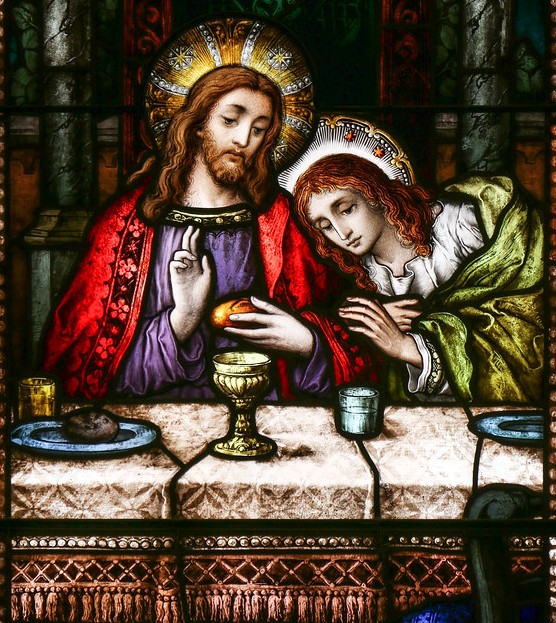
Maximus of Turin (d. 465) was a disciple of St. Ambrose of Milan and the first bishop of Turin. In his sermon for Epiphany he reflects on St. John reposing upon the breast of his Lord at the last supper. He sees the actions of the Apostle that night not only as a display of his profound love and trust in Christ, but a display of the profound humility of Christ Himself, who draws His saints to share in His rest so that He might repose in their hearts. Interestingly, John Boys, the dean of Canterbury during the reign of King James I, quotes a passage from this sermon in his reflections for St. John’s Day (mistakenly attributing the quote to St. Ambrose).
[Christ] is held, then, by His mother at her breast when He is born, but His Father unceasingly extends the warmth of His breast to Him, for we read that He always reposes in the Father’s bosom, as the Evangelist says: No one has ever seen God except the only-begotten Son, who is the Father’s bosom. Willingly, therefore, does the Lord repose in the bosom of the saints — which is why He chose the breast of John the Evangelist — so that they might rest in Him. But the bosom upon which Christ finds rest is not furnished by the corporeal breast nor is it covered with splendid clothing, but it is composed of the practice of the heavenly virtues. In John the Evangelist the bosom for Christ was faith, in God His Father it is divinity, and in Mary His mother virginity. Where there is a dwelling for the virtues, there is a bosom for Christ; where He finds the lodging of the heavenly commandments, there He lays His head.

 EPISTOLÊ