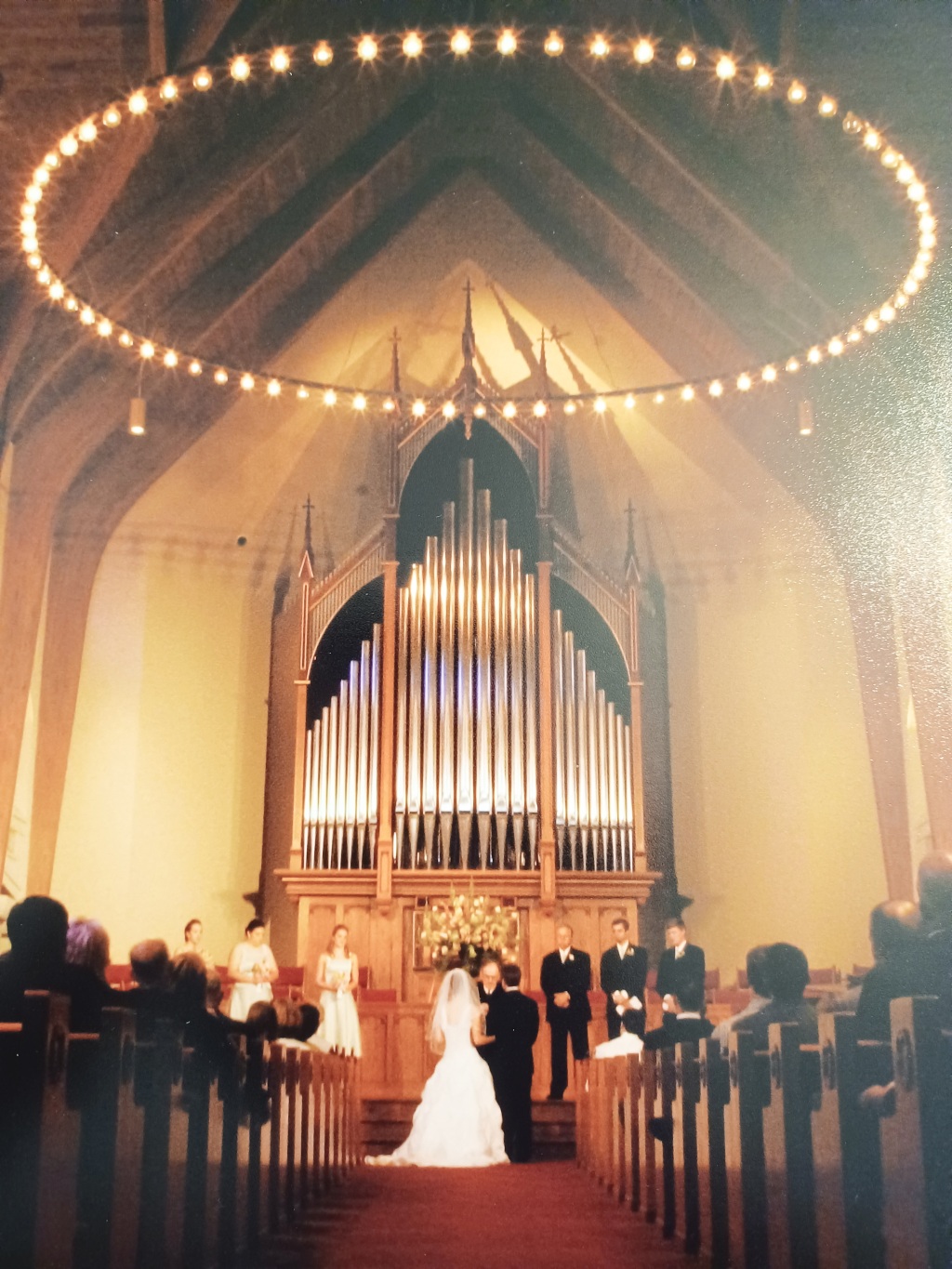
Today marks 18 years since my wife and I were married. My life and character have been so fundamentally altered since that day that I hardly recognize the boy in the photos. The joining of two souls is the making of a world, a society with memories eternal. Marriage is a gift that takes a lifetime to unwrap. The joining of two souls requires a rebirth, to be born not of flesh and blood but of God. “It is he who hath made us and not we ourselves.” This is not your personal society after all. Marriage is a world made in the image of the Trinity – Love begetting Love, in a single breath of Love. Wendell Berry says, “The room of love is another world. You go there wearing no watch, watching no clock. It is the world without end, so small that two people can hold it in their arms, yet it is bigger than worlds on worlds, for it contains the longing of all things to be together…” (Hannah Coulter, 110).
Marital love between a man and a woman is not a passion or an ecstatic devotion but an institution, one long stable structure with rooms big enough to envelope your own particular parcel of that “eternal longing of all things to be together.” We wanted to be together and we didn’t want anyone else to be there but the One in whom all things are eternally held together. We knew we couldn’t hold it together alone. Many times there’s been a palpable sense that it had to be held together by some force other than our own, not because of some bliss we felt, but because of the human tendency to violate the sacred, to break into the garden, to take what must only be given. Let yourself go, forget that marriage is an institution made by God, and everything collapses quickly, like pulling a stone from the base of a wall. I look around me and I see so many broken walls, marriages ruined, people I know, whose relationships I once admired. When I look at our marriage, my wife married to the chief of sinners, I say with Toplady, “Nothing in my hands I bring / simply to Thy cross I cling.” Marriage is cruciform. You’ll die a thousand deaths, but if Christ is in it, and you both believe it, each time you’ll be born again.
Love is like God, a consuming fire. For those who give themselves up to it, it does not destroy but it consumes the dross, leaving behind something pure. Love leaves marks. It sometimes makes us think we’re losing ourselves, our individuality, but holy matrimony is an ancient philosophical way of life, promising as Socrates once did, to return us to ourselves better than we were before. I still attend this philosopher’s school daily, striving to create enough room to hold that eternal desire of all things to be together. Our love has begotten three loves, who are more precious to us than a thousand worlds. They burn like flames as well, drawing us even closer together with an unbreakable bond. We are content to dwell here where God comes to walk with us in the cool of the day, while we pray for that contentment, which Traherne called “a long habit of solid repose.” We live this way in our domestic monastery where we’re governed by the Prayer Book rule of love. What is the Daily Office from the Prayer Book when read by the whole family but the language of the marriage liturgy transposed into common prayer? What is it when mother, father, and children united their voices to praise the author of Love, but the fruit of that oath that they made, “to have and to hold, to love and to cherish, to honor and obey”? Marriage is an ascension offering, a perpetual ‘sursum corda’ raising a new humanity up to the heavens to reign as kings on earth.
Only after Adam named all of the animals did God give him a woman, whom he did not immediately name, but praised poetically as “bone of my bone and flesh of my flesh.” The union of husband and wife transcends all naming, but the reality is beheld in praise. Looking back to that wedding day, the memory of what I understood about love and commitment is faded, distorted, like faces viewed through the heat of a flame. The eternal is what abides in memory, the flame itself, the presence of Christ, his promise, his blessing. “Those whom God hath joined together, let no man put asunder.” And so we abide content, in the room of love, offering sacrifices of praise and thanksgiving with our loves to the God of Love, “til death us do part.”

 EPISTOLÊ