Within the spirit of the post below concerning snobbery, I suggest that we who rummage through the old dusty pages of theological and philosophical works of days long past adhere to the commonsensical maxim to never create a problem of diverging doctrinal paradigms where an author him/herself did not. For example, I have not read in any Reformer where he disagrees with the “papists” because they view Christ, man, and sin through a dualist nature/grace paradigm. The anachronistic insertion of such a paradigm would amount to something similar to what C.S. Lewis termed “chronological snobbery.” Therefore, I vow not to insert a problem of dueling “worldviews” where Luther, et al. did not. Steven has an excellent post for those wanting to know the problems of “worldview thinking.”
Rather than disagree with Rome because of its worldview Calvin and Vermigli opposed what may seem to us as non-essential if not insignificant doctrinal points. It is really easy for us to read the polemics of Luther or Calvin anachronistically, as if they would both be just as militant about some of these points were they living in 21st century Europe or America. As James Davison Hunter points out, the religious situation in America is no longer divided between Protestant and Catholic, as it was in the 19th and earlier centuries. Rather, we are divided between those who adhere to the authorities of church or Bible and those who value the authority of reason and the freedom to critique supernatural authorities. Sure, Protestants and Catholics are still divided in terms of doctrine and practice. However, one can notice the change in rhetorical tone toward a spirit of mutual respect that did not exist for the Reformers.
I am somewhat grieved to bring up a “whipping boy” to accentuate my point, since he is someone who has taught me many things. Herman Bavinck is that “boy.” First, I must emphasize my respect for Bavinck. I agree with Richard Gaffin, that Bavinck’s is “Arguably the most important systematic theology ever produced in the Reformed tradition.” With that said, I offer one critique. Bavinck makes the following statement concerning the Reformed understanding of Adam’s original state:
[For the Reformers] grace serves, not to take up humans into a supernatural order, but to free them from sin. Grace is opposed not to nature, only to sin. In its real sense, it was not necessary in the case of Adam before the fall but has only become necessary as a result of sin […] Grace does not give us any more than what, if Adam had not fallen, would have been acquired by him in the way of obedience. The covenant of grace differes from the covenant of works in method, not in its ultimate goal. It is the same treasure that was primised in the covenant of works and is granted in the covenant of grace. Grace restores nature and takes it to its highest pinacle, but it does not add to it any new and heterogeneous constituents. (Reformed Dogmatics, Vol. 3: Sin and Salvation in Christ, p. 577.)
Now, I must add one caveat to this quote, which I think is a misinterpretation of the Reformers: Bavinck is critiquing the Catholic doctrine that Adam was created in a state of “pure nature.” According to this doctrine, man was originally created without supernatural gifts, his nature remains constant before receiving grace, while grace is given, and after grace has been removed because of the fall. Throughout the process Adam’s nature remains as it was created. This was a position held by many Jesuits during the time of Francis Turretin. Peter Leithart notes here that Turretin attributed this position to Pelagianism, both old and new – as did Vermigli. Therefore, inasmuch as Bavinck critiques the notion of pure nature he is correct. The Reformers did not hold to this position. However, by stating that the Reformers did not believe Adam needed grace before the fall Bavinck misrepresents at least two Reformers: John Calvin and Peter Martyr Vermigli.
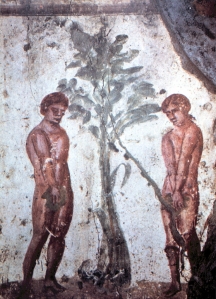 Calvin affirms that Adam was created in the image of God with the “adornments” of wisdom, virtue, and justice, and he calls these the “gifts” which God “willed to be conferred upon human nature.” (Institutes, II.I.4-7.) But, throughout the Institutes Calvin seems to equate man’s original state with human nature. He seems to imply that Adam did not have sanctifying grace “superadded” to his nature. Rather, Adam was created with these gifts, and those gifts are natural. At this point I must state clearly that the word “nature” can cause much confussion. What did Calvin mean by “nature”? Fortunately, he gives us an idea of his definition when he explains the meaning of “corruption of nature”:
Therefore we declare that man is corrupted through natural vitiation, but a vitiation that did not flow from nature. We deny that it has flowed from nature in order to indicate that it is an adventitious quality which comes upon man rather than a substantial property which has been implanted from the beginning. Yet we call it “natural” in order that no man may think that anyone obtains it through bad conduct, since it holds all men fast by hereditary right. (Ibid., II.I.11.)
Here Calvin uses the word “nature” to refer both to man’s original state as created by God and his state after the fall. Adam has a nature before the fall and a nature after the fall, but he maintains the same nature/substance throughout. In other words, his substance remains yet it receives the “adventitious quality” of original sin. Calvin explains, “in man’s perverted and degenerate nature some sparks still gleam. These show him to be a rational being, differing from brute beasts, because he is endowed with understanding.” (Ibid., II.II.12.) Therefore, the definition of man as a rational animal, which is his nature, does not change after the fall, and thus original sin is something added to that nature. We can see something similar with Calvin’s understanding of nature and grace. He explains that some gifts are natural but others are above nature:
I feel pleased with the well-known saying which has been borrowed from the writings of Augustine, that man’s natural gifts were corrupted by sin, and his supernatural gifts withdrawn; meaning by supernatural gifts the light of faith and righteousness, which would have been sufficient for the attainment of heavenly life and everlasting felicity. Man, when he withdrew his allegiance to God, was deprived of the spiritual gifts by which he had been raised to the hope of eternal salvation. Hence it follows, that he is now an exile from the kingdom of God, so that all things which pertain to the blessed life of the soul are extinguished in him until he recover them by the grace of regeneration. Among these are faith, love to God, charity towards our neighbour, the study of righteousness and holiness. All these, when restored to us by Christ, are to be regarded as adventitious and above nature. If so, we infer that they were previously abolished. (Institutes, Henry Beveridge, trans., II.II.12.)
In this paragraph Calvin affirms both a sin/grace distinction and a nature/grace distinction, or more properly a nature/supernatural distinction. Adam was created with certain supernatural gifts added to his natural gifts in order that he attain a supernatural end. After the fall this nature/supernatural distinction in gifts does not disappear but a new category is added, that of sin. Therefore, we can tentatively conclude that Calvin did not consider Adam’s original righteousness to be purely natural, not needing the addition of grace (as Bavinck implies), nor can we reduce his soteriology to a mere sin/grace distinction. Because Adam was created with supernatural gifts we can say that these gifts were natural (I think this is what Bavinck means by the term) and in this sense no addition was needed. However, this does not mean that these gifts were produced from nature, but that Adam had a natural capacity to receive them. Adam’s faith, hope, and charity were not products of nature but were given supernaturally by God at the time of creation.
I believe that a nature/grace distinction (as opposed to a sin/grace distinction) within the writings of Calvin and Vermigli is difficult to find because they considered the removal of original righteousness to be a sin in and of itself, as Calvin mentions in the quote above. Therefore, a post-lapsarian sin/grace distinction is the same as a post-lapsarian nature/grace distinction because a nature without grace in this world is a corrupt nature. Because Calvin uses the word “nature” in reference to Adam’s originally righteous state he can say that any removal of grace is a corruption of nature, rather than a return to a state of pure nature. Also, the use of the word “nature” when distinguished from “grace” denotes a metaphysical definition, something that Calvin sought to avoid in order to be perspicuous. In the next post I will discuss Thomas Aquinas’s understanding of this topic and compare texts from he, Vermigli and Calvin in which they discuss Adam’s original state.


 EPISTOLÊ